
We design and manufacture plants that run on natural refrigerants — CO₂ (R744) and ammonia (R717). Not as a statement of intent, but because it settles two questions early: what happens to the charge over the life of the plant, and what happens to the heat.
CO₂ (R744) and ammonia (R717) occur in nature. Neither is a fluorinated gas, and that single fact removes a running question from an industrial investment: what the refrigerant in your plant will cost, and how easily you will get it, years after commissioning. A natural refrigerant carries no conversion project waiting at the end of it. Our whole product range is built on this — CO2PRO for CO₂ systems, NH3PRO where ammonia is the better answer. The lifetime of the plant is then decided by the plant.
Every cooling process makes heat. Most plants throw it away — to sea, to air, to a roof. CO₂ is well suited to recovering that heat and putting it back into a building or a process. CO2PRO Chiller/Heat is a CO₂ water-to-water chiller and heat pump in one unit, and can be supplied with an ejector where cooling and heating are needed at the same time. Our freezing plants can be supplied with heat recovery as an option. Indicative capacity is up to 400 kW on a single compressor.
CO₂ is non-toxic and does not require fire-rated EX rooms. In practice that shortens the conversation with the yard, the fire strategy and the general arrangement drawing: the plant can sit closer to the load, in less space, with less built around it. Our units are compact and corrosion-protected for coastal installations, and Chiller/Heat can be supplied with class approval – DNV, BV or Lloyd's Register. Where ammonia is the better thermodynamic answer, we build NH3PRO instead — with the handling and room requirements ammonia properly carries.
Our plants run on PLC-based control with our own HMI, integrated flow measurement, and remote monitoring with alarm handling. That is not a feature list — it is how a claim becomes a measurement. Our valve control can be run from the same interface, so the whole installation is operated and visualised in one place. When flow, temperatures and running state sit on one screen, over-consumption appears as a trend rather than as a surprise on an invoice, and a service decision can be made on data instead of on a hunch.
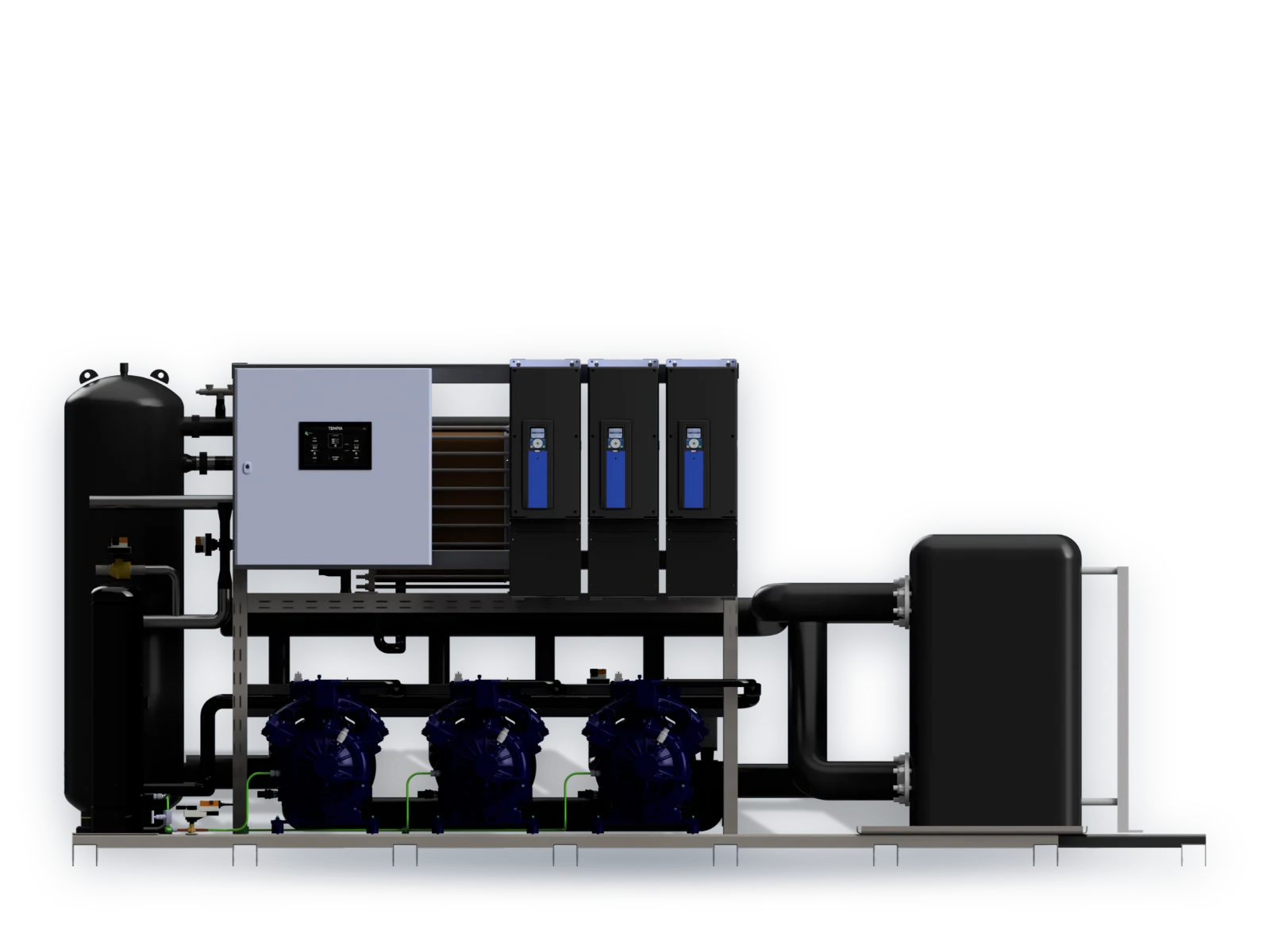
We develop, manufacture and commission from Svolvær, in the same house. That matters environmentally for an unglamorous reason: a plant that can be kept running, upgraded and rebuilt does not have to be replaced. Parts, upgrades, conversions and energy improvements on plants already in operation keep them efficient for longer. Holding a working machine at its designed efficiency for another decade is a larger environmental result than most product claims.
We do not publish a saving percentage on this page, because we cannot know yours. Efficiency on a real plant follows source temperature, sink temperature, load profile and running hours — change any one of them and the number changes with it. So the figures we give you are indicative, stated with the conditions they were calculated under, and confirmed in the design phase. Tell us the duty, the temperatures and the hours, and we will do the arithmetic before you commit to anything.
Talk to an expert if you are still scoping the job, or request a quote if you already have a duty and a deadline. Either way you reach the same engineers in Svolvær. We do not publish prices, because every delivery is engineered to the case and a quote follows a specification.